
Plain language articles from OC Wellness in Newport Beach. General education, not medical advice.
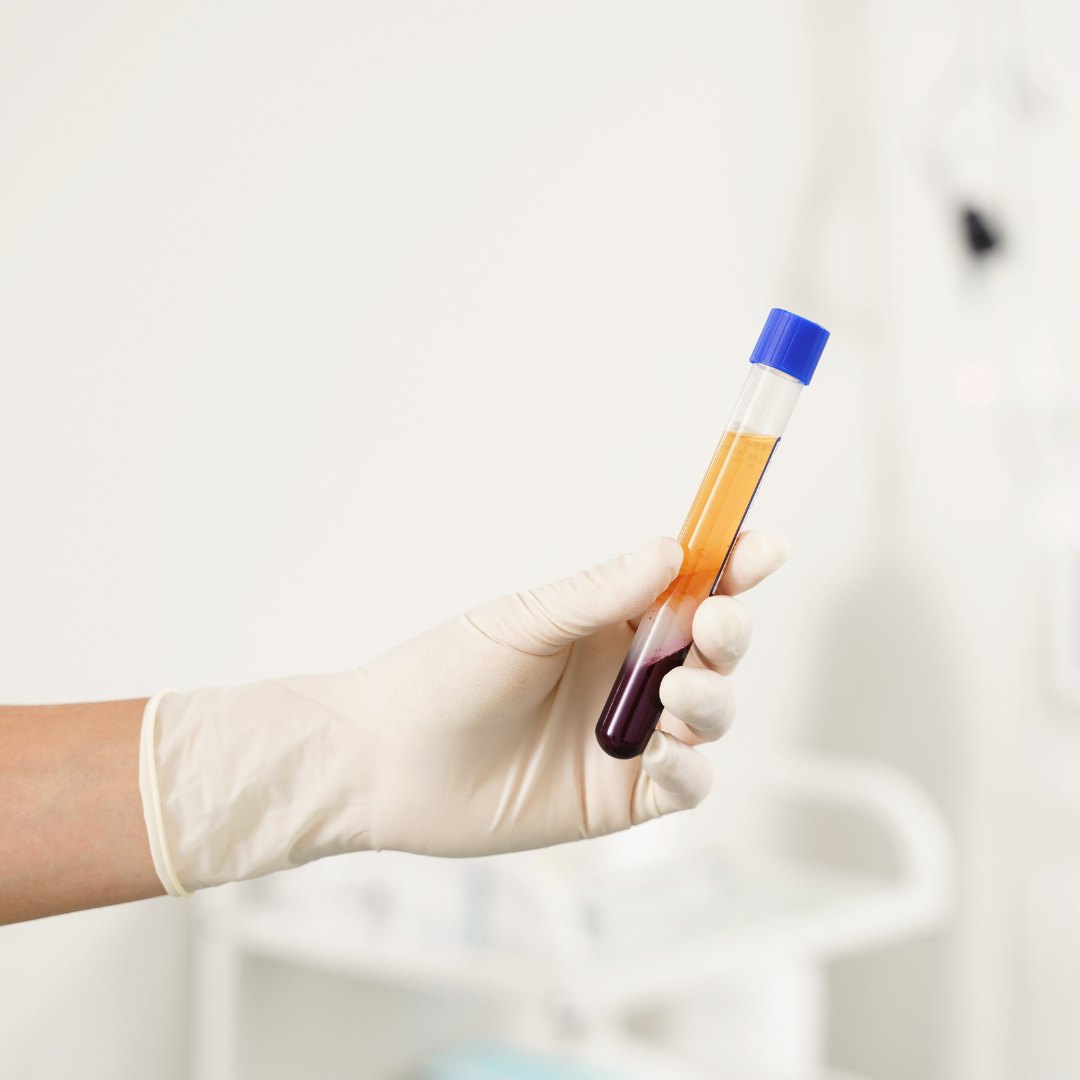

Quick answer: PRP and PRF are both concentrates made from a small sample of your own blood. PRP is spun with an anticoagulant and releases its growth factors quickly. PRF is spun without additives, forms a soft fibrin gel and releases growth factors more slowly. Research has not shown that either one is better for any condition, so the right choice depends on the area being treated and the evidence for it.
Key takeaways
Same source. Both come from your own blood, drawn at the same visit, so there is no donor material involved
Different preparation. PRP uses an anticoagulant and often two spins. PRF uses no additives and one gentler spin
Different release. PRF releases growth factors over several days in the lab. PRP releases them faster
No clear winner. Few studies compare the two directly in patients, and most are small
Ask about the evidence. A good clinic will tell you which one it uses for your concern and why
What are PRP and PRF?
Both treatments start the same way. A clinician draws a small tube of blood from your arm and spins it in a centrifuge. Spinning separates the blood into layers, so the platelets can be collected in a smaller volume of plasma. Platelets are best known for helping blood clot, but they also carry proteins called growth factors that signal nearby cells to repair tissue and form new blood vessels.
PRP stands for platelet rich plasma. PRF stands for platelet rich fibrin. Researchers often call PRP the first generation and PRF the second generation of these concentrates. That label describes when each was developed. It does not mean one is an upgrade of the other.
How PRP and PRF are prepared differently
The anticoagulant
PRP tubes contain a medicine that keeps the blood from clotting while it is spun, and PRP is often spun twice to concentrate the platelets further. Some protocols also add an activator before injection. PRF tubes contain no anticoagulant or activator, and the blood is spun once at a slower speed.
The fibrin scaffold
Because nothing stops it from clotting, PRF begins to form a soft gel of fibrin, the same protein that holds a natural blood clot together. That gel traps platelets and some white blood cells, which is why PRF tends to release its growth factors gradually rather than all at once.
Timing in the room
PRF has to be used within minutes of the blood draw, before it gels completely. PRP is more forgiving, which gives the clinician more flexibility during the procedure.
White blood cells
Different systems collect different amounts of white blood cells. Some studies suggest this matters for how much inflammation follows an injection, but the research is not settled.
What laboratory research shows
In laboratory experiments, fibrin based preparations have released growth factors such as TGF beta, PDGF and VEGF more slowly and over more days than PRP gels, which tended to break down within a few days. That is a real difference in how the products behave. It does not prove that a slower release leads to a better result in a person, and that is the question patients care about.
What clinical research shows
Skin rejuvenation
Reviews of facial rejuvenation studies report improvements in skin thickness, texture and elasticity for many patients, with few serious side effects. Most of those studies used PRP. Only a handful compared PRP with PRF directly, the groups were small and the ways results were measured varied from study to study.
Hair loss
Pooled randomized trials have found that PRP increased hair density compared with placebo at three and six months in pattern hair loss. Results for hair count and hair thickness were less consistent. Research on PRF for hair is encouraging but smaller and earlier.
Joints
PRP has the most research for knee arthritis and some tendon problems. PRF research for joints is still early.
The honest summary
Both are reasonable options in the right setting. Neither has been proven better than the other, and better head to head trials are still needed.
Are PRP and PRF FDA approved?
The devices used to prepare PRP and PRF are cleared by the FDA for preparing blood products. Injecting PRP or PRF into the skin, scalp or a joint is not an FDA approved use, and your clinician should explain that before you begin. That is common for procedures that use your own tissue, but it is something you should hear plainly.
Side effects and who should wait
Most people have soreness, swelling or bruising at the injection site for a few days. Because the product comes from your own blood, an allergic reaction to it is not expected. As with any injection, infection is possible but uncommon when sterile technique is used. We postpone treatment with an infection in the area, during cancer treatment, with certain blood or platelet disorders, or while taking medicines that affect platelets, and we review blood thinners with you first.
Questions to ask any clinic
Which preparation will you use for me, and why that one? How is it prepared, and how many platelets does it contain? What does the research show for my specific concern? Who performs the injection, and how often have they done it? How many sessions do you expect, and what is the full cost in writing? A good clinic answers these without hesitation.
How OC Wellness approaches PRP
We start with an exam and a clear conversation about your goal, whether that is skin quality, thinning hair or a painful joint. We explain what the evidence shows for that use, what results are realistic and how many sessions it usually takes. If another treatment fits your situation better, such as medicine for hair loss or physical therapy for a tendon, we will say so.
Questions patients ask
Is PRF better than PRP?
Not proven. PRF releases growth factors more slowly in laboratory studies, but few studies compare the two directly in patients.
Does PRF use someone else's blood?
No. Both PRP and PRF are made only from your own blood, drawn at your visit.
Which is used for hair loss?
PRP has the larger body of research for pattern hair loss. PRF studies are smaller but encouraging.
Are there side effects?
Most people have soreness, swelling or bruising at the injection site for a few days. An allergic reaction to your own blood product is not expected.
How many sessions will I need?
It depends on the area. Many skin and hair plans use about three sessions a month apart, then maintenance.
Is PRP or PRF covered by insurance?
Usually not, because these uses are considered cosmetic or not FDA approved. OC Wellness is a self pay practice.
Book a visit in Newport Beach
Learn more on our PRP therapy and hair restoration pages, or book a consultation to talk through which option fits you. Call 949.222.0232, Monday to Thursday, 9 am to 5 pm. OC Wellness is a self pay practice and does not accept Medicare or bill insurance. Consultations start at $350, and you receive your plan and its full cost in writing before anything is ordered.
Sources
Calciolari E, et al. Platelet concentrates review. Periodontology 2000, 2025.
Zhang X, et al. Platelet rich plasma for androgenetic alopecia: meta analysis of randomized trials, 2023.
Dohan Ehrenfest DM, et al. Growth factor release from L PRF and pure PRP, 2012.
Qin H, et al. Platelet concentrates for facial rejuvenation: systematic review. Ann Plast Surg, 2025.
This article is general education, not medical advice, and reading it does not create a doctor patient relationship. Whether a treatment is right for you depends on an exam by a licensed clinician. Results vary from person to person, and no result is guaranteed. If you think you are having a medical emergency, call 911.